Papurana daemeli
Wood frog
Distribution
:quality(60)/https%3A//media.frogid.net.au/media/dd/images/h6ciiocc3ddzttk8xgkt.1c170e2.png)
Conservation Status
What does it mean?
 Federal Conservation Status (EPBC Act)
IUCN Red List
 Least Concern
Frog Calls
Call recorded by Justin McMahon
Call recorded by Justin McMahon
Call recorded by Justin McMahon
Calling Period
- Jan
- yes
- Feb
- yes
- Mar
- yes
- Apr
- yes
- May
- yes
- Jun
- yes
- Jul
- yes
- Aug
- yes
- Sep
- yes
- Oct
- yes
- Nov
- yes
- Dec
- yes
Species Information
Description
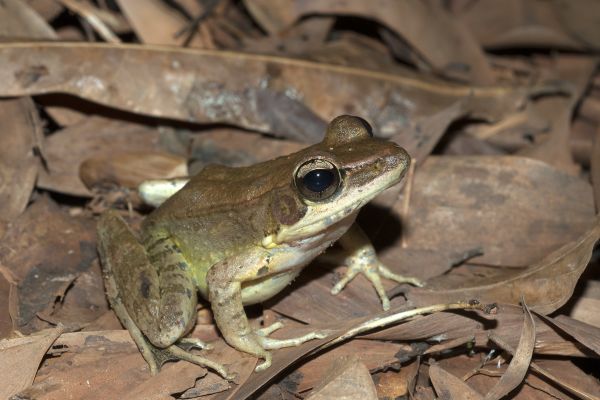
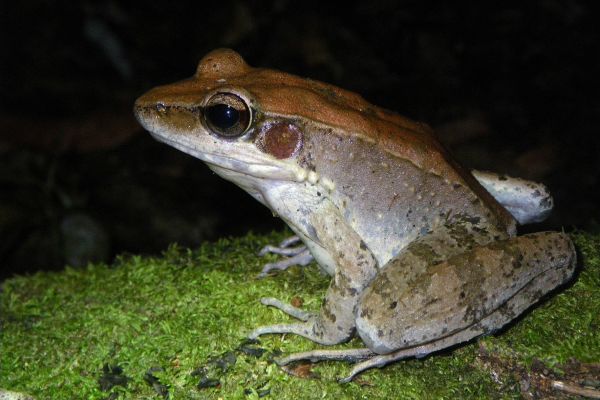
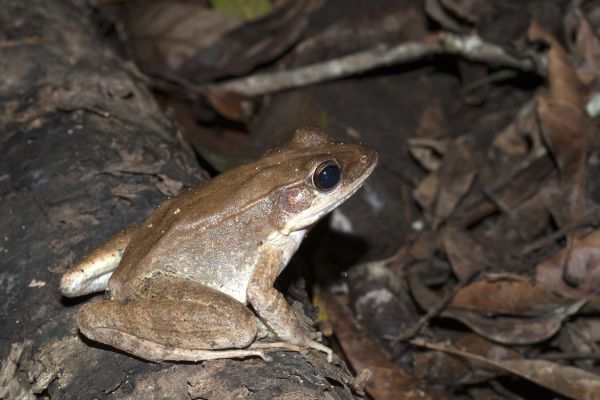
A large species of frog reaching up to 8 cm in body length. It has a brown, dark brown or bronze back, with a distinct brown stripe from the tip of the snout to the lower back that divides the back from the side, sometimes clearly separating the different colours of each area. There is a white stripe along the upper lip. The belly is white. The pupil is horizontal, and the iris is gold. The legs and arms have pale brown horizontal bars. Fingers are unwebbed and toes are fully webbed, both with small discs. It is the only Australian frog species with a vocal sac that inflates on both sides of the jaw.
Habitats
Occurs in rainforest and near rivers and creeks in scrubland.
Breeding Biology
Eggs are laid as clusters that float as a single layer at the surface of stream pools and swamps. Tadpoles can reach a total length of 6 cm, and are dark brown or black in colour. Young tadpoles have a unique newt tadpole appearance. They often remain on the bottom of water bodies; it is unknown how long they take to develop into frogs. Breeds during spring to summer, but may breed any time of the year after rain.
Similar Species
Looks similar to Litoria inermis, Litoria latopalmata, Litoria nasuta, Litoria nigrofrenata, Litoria pallida, Litoria tornieri, and Litoria watjulumensis in its distribution, but has pale brown horizontal bars on the arms and legs, and a more distinct brown stripe from the tip of the snout to the lower back.