Adelotus brevis
Tusked Frog
Distribution
:quality(60)/https%3A//media.frogid.net.au/media/dd/images/mcnnrivwiopkqueva7oc.504e863.png)
Conservation Status
What does it mean?
 Federal Conservation Status (EPBC Act)
IUCN Red List
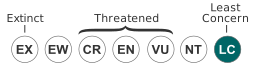 Least Concern
Frog Calls
Call recorded by Athol Lester
Calling Period
- Jan
- peak
- Feb
- yes
- Mar
- yes
- Apr
- possible
- May
- possible
- Jun
- possible
- Jul
- possible
- Aug
- yes
- Sep
- peak
- Oct
- peak
- Nov
- peak
- Dec
- yes
Species Information
Description
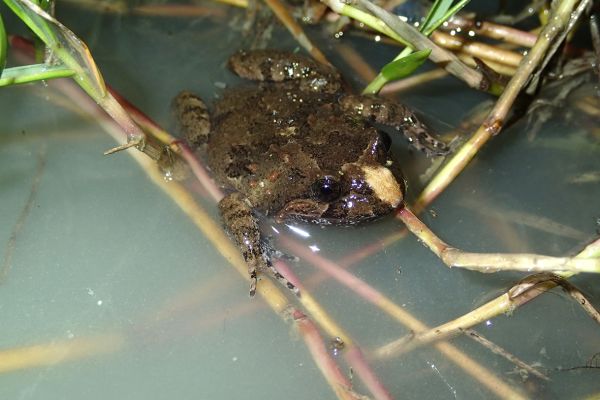
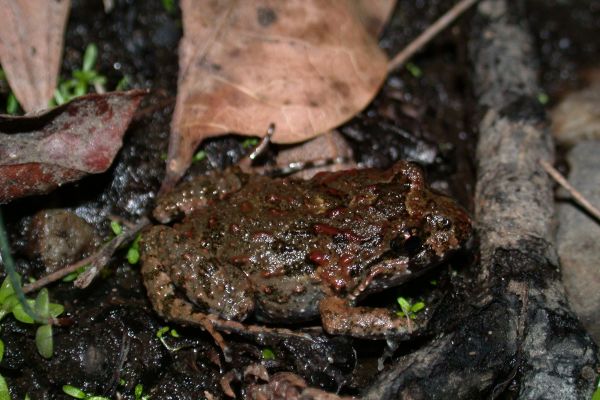
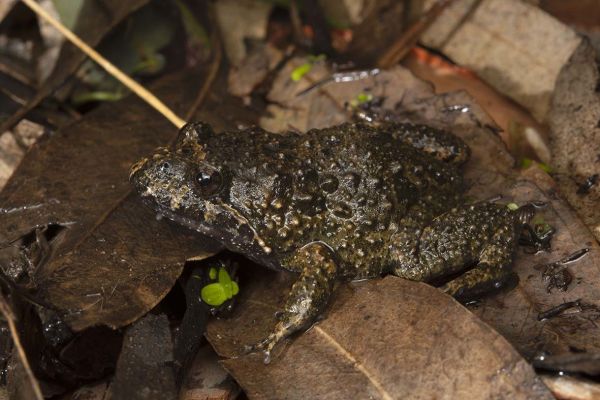
This small but remarkable frog has pointed “tusks” on their lower jaw. Males of the species have much larger heads and bigger tusks than females, and they use the tusks to fight with other males in defense of breeding sites. The quiet call of this species is commonly heard at breeding sites throughout its range, but this secretive and particularly aquatic species is rarely seen. A medium-sized species of frog reaching up to 5 cm in body length. It has a dark brown or dark grey back, with a butterfly-shaped marking between the eyes. The belly is marbled black and white. The pupil is horizontal and the iris is golden brown. The thighs and lower legs have bright red patches. Fingers are moderately webbed and toes are slightly webbed, both without discs.
Habitats
Occurs in wet forest, rainforest, dry forest and farmland.
Breeding Biology
Eggs are laid as a foamy mass on the surface of permanent ponds, stream pools, water-filled crayfish holes, or cattle tracks. Tadpoles can reach a total length of 3.5 cm and are dark brown in colour, sometimes with a cream-coloured patch on the snout. They often remain at the bottom of water bodies and take around two months to develop into frogs. Breeds during spring and summer.
Similar Species
Looks similar to Crinia deserticola, Crinia parinsignifera, Crinia signifera, Crinia tinnula, Uperoleia fusca, Uperoleia laevigata, Uperoleia rugosa, Paracrinia haswelli and Pseudophryne bibronii in its distribution, but the Uperoleia species lack the butterfly-shaped marking between the eyes and the Crinia species and Pseudophryne bibronii lack the bright red patches on the thigh and lower leg. Paracrinia haswelli has additional bright red patches in the armpits that are not present in Adelotus brevis.