Anstisia alba
White-bellied Frog


Distribution
:quality(60)/https%3A//media.frogid.net.au/media/dd/images/e2reiwkza0yid1i97sgb.4a172da.png)
Conservation Status
What does it mean?
 Federal Conservation Status (EPBC Act)
IUCN Red List
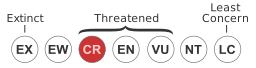 Critically Endangered
Frog Calls
Call recorded by Dale Roberts
Call recorded by Grant Webster
Calling Period
- Jan
- No calling
- Feb
- No calling
- Mar
- No calling
- Apr
- No calling
- May
- No calling
- Jun
- No calling
- Jul
- No calling
- Aug
- yes
- Sep
- yes
- Oct
- yes
- Nov
- yes
- Dec
- yes
Species Information
Description
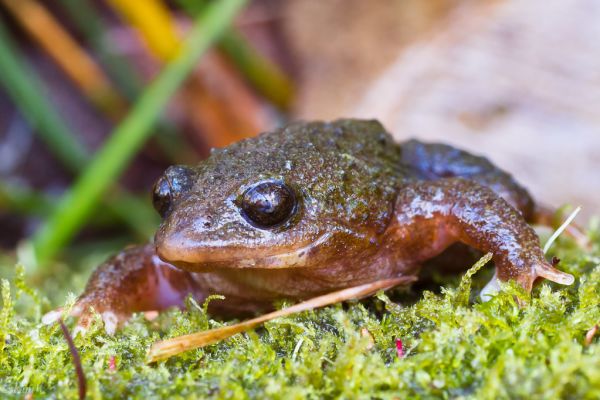
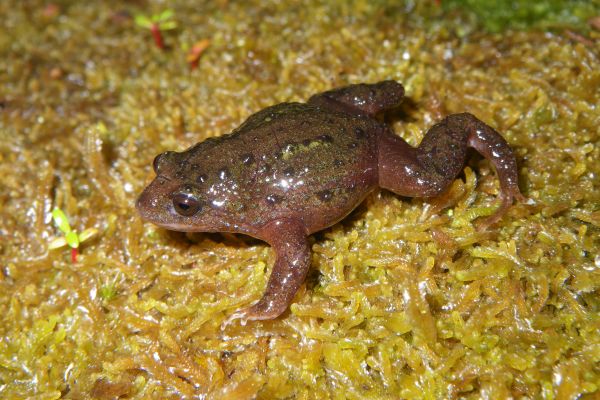
A small species of frog reaching up to 2.5 cm in body length. It has a brown or grey back, with distinct rows of dark brown bumps along each side of the middle. The belly is white, with a pale yellow tinge.
The pupil is horizontal, and the iris is dark brown. Fingers and toes are unwebbed, both without discs. Juveniles have a black belly, with metallic blue specks.
This species was previously in the genus Geocrinia, but research published in 2022 recognised this species, along with three other closely related species, as distinct and placed them in the newly-described genus Anstisia, in honour of Australian Museum Research Associate Dr Marion Anstis.
Habitats
Occurs in seepages near creeks in coastal forest.
Breeding Biology
Eggs are laid as a small cluster on land in wet peat soil burrows hidden by vegetation. Tadpoles can reach a total length of up to 1.5 cm and are brown in colour, with metallic bright blue specks. They never swim in water; instead they develop inside the broken egg jelly mass, feeding entirely on their own gut yolk reserves, and take around one to three months to develop into frogs.
Breeds during late winter to early summer.
Similar Species
Looks similar to Crinia georgiana, Crinia glauerti, Crinia pseudinsignifera, Geocrinia leai, and Anstisia vitellina in its distribution, but has a different belly colour to all of these species.