Arenophryne rotunda
Northern Sandhill Frog
Distribution
:quality(60)/https%3A//media.frogid.net.au/media/dd/images/neohvs8ezuv1lro1rvdl.ff5c001.png)
Conservation Status
What does it mean?
 Federal Conservation Status (EPBC Act)
IUCN Red List
 Least Concern
Frog Calls
Call recorded by Dale Roberts
Calling Period
- Jan
- No calling
- Feb
- No calling
- Mar
- No calling
- Apr
- No calling
- May
- No calling
- Jun
- No calling
- Jul
- yes
- Aug
- yes
- Sep
- yes
- Oct
- yes
- Nov
- yes
- Dec
- possible
Species Information
Description
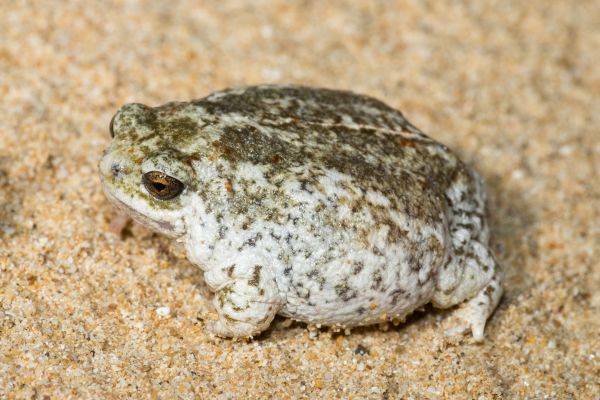
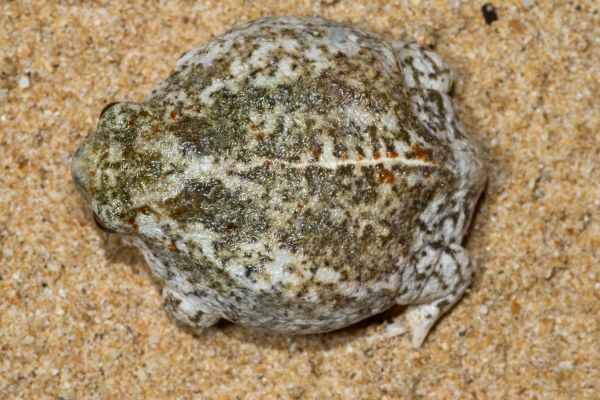
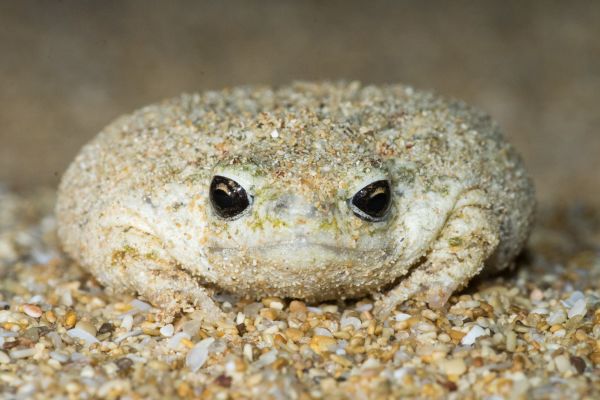
A medium-sized species of frog reaching up to 4 cm in body length. It has a white or grey back, with mostly black but some red patches and spots. There is often a thin, cream-coloured longitudinal stripe along the middle of the back. The belly is white, with a large dark patch in the middle. The pupil is horizontal and the iris is gold. Fingers and toes are unwebbed, both without discs. The fingers are very wide and short, and are used for digging head first into sand. This is very rare among Australian burrowing frogs as most burrow backwards so that their legs go under the surface first.
Habitats
Occurs in arid coastal sand dunes.
Breeding Biology
Eggs are laid on land as a single, small clutch underground in wet sandy burrows. There is no true tadpole stage; all development takes place inside the egg before little frogs emerge, a process that lasts around two months. Breeds during autumn before winter rains and during winter to spring.
Similar Species
Looks very similar to Arenophryne xiphorhyncha, but has a slightly different distribution and a lighter coloured back.