Colleeneremia balatus
Slender Bleating Tree Frog
Distribution
:quality(60)/https%3A//media.frogid.net.au/media/dd/images/g3uafuankfbh3f6wnfwe.6b033a7.png)
Conservation Status
What does it mean?
 Federal Conservation Status (EPBC Act)
IUCN Red List
 Least Concern
Frog Calls
Call recorded by Christine Haworth
Call recorded by Mandy McCosker
Calling Period
- Jan
- peak
- Feb
- peak
- Mar
- yes
- Apr
- possible
- May
- possible
- Jun
- possible
- Jul
- possible
- Aug
- yes
- Sep
- yes
- Oct
- peak
- Nov
- peak
- Dec
- peak
Species Information
Description
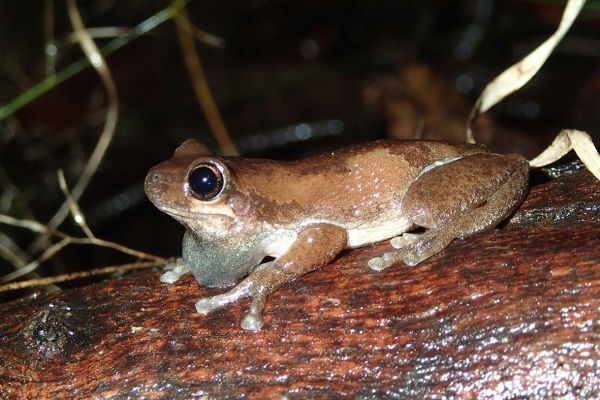
A medium-sized species of frog reaching up to 4.2 cm in body length. It has a light brown or cream-coloured back, with a wide, brown longitudinal stripe along the middle. The belly is cream-coloured, and the male has a black vocal sac. The pupil is horizontal, and the iris is red in the top half and brown in the lower half. Fingers are one-third webbed and toes are three-quarters webbed, both with large, sometimes yellow discs. This species was named as new to science in 2021 by a team of researchers including from the Australian Museum. The species was previously being confused with Colleeneremia dentata. Recordings submitted to FrogID were analysed as part of the scientific paper formally describing and scientifically naming the species. Your recordings really do contribute to better understanding and conserving our frogs! This species was previously known as Litoria balatus.
Habitats
Occurs in open forests, woodlands and occasionally rainforest.
Breeding Biology
Breeds in shallow ephemeral drainage lines, wetlands, as well as in small dams. Much of its breeding biology is unknown, but is likely similar to Litoria dentata.
Similar Species
Most similar to Colleeneremia dentata and Colleeneremia quiritatus. It does not overlap in range with Colleeneremia quiritatus but may overlap slightly with Colleeneremia dentata around the Scenic Rim region of Queensland. It can be distinguished from Colleeneremia dentata by having a more slender build, a pale dorsolateral line that runs to the groin (versus diffusing around the arm), and males with a black vocal sac versus a dirty yellow or brown when inflated. Looks somewhat similar to Colleeneremia rubella, and Rawlinsonia verreauxii in its distribution. It can be distinguished from Rawlinsonia verreauxii by a lack of bright colours in the armpits or back of the thighs, while Colleeneremia rubella lacks the wide, brown longitudinal stripe along the middle of its back and has a more robust body.