Crinia georgiana
Quacking Frog
Distribution
:quality(60)/https%3A//media.frogid.net.au/media/dd/images/tknd3ylfjitxc0hxrqps.3293d97.png)
Conservation Status
What does it mean?
 Federal Conservation Status (EPBC Act)
IUCN Red List
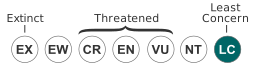 Least Concern
Frog Calls
Call recorded by Tracy Redwood
Call recorded by Dale Roberts
Call recorded by Grant Webster
Calling Period
- Jan
- No calling
- Feb
- No calling
- Mar
- No calling
- Apr
- possible
- May
- possible
- Jun
- yes
- Jul
- peak
- Aug
- peak
- Sep
- yes
- Oct
- yes
- Nov
- yes
- Dec
- possible
Species Information
Description
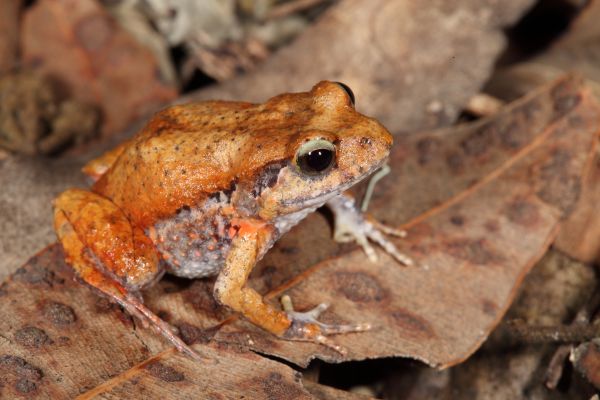
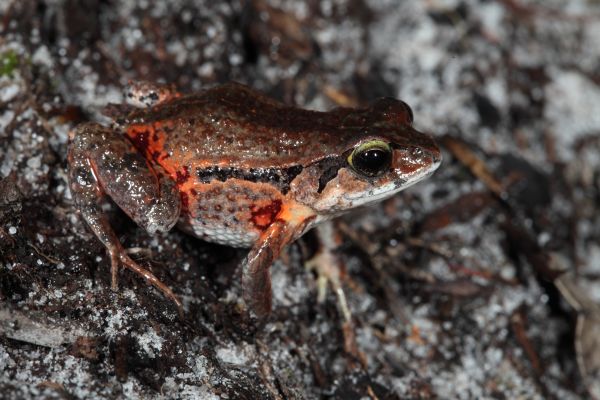
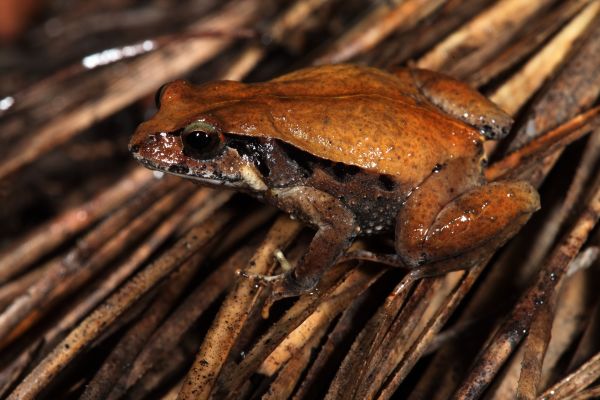
A medium-sized species of frog reaching up to 4.5 cm in body length. It has a grey, brown, reddish-brown, cream-coloured or nearly black back, with or without darker patches or stripes. There is sometimes a longitudinal stripe along the middle of the back. The eyelids are red or gold. The belly is white and the male has a dark brown throat. The pupil is horizontal and the iris is gold. The armpits, groin, and front and back of the thighs are bright red. Fingers and toes are unwebbed, both without discs. The male has distinctly larger arms than the female.
Habitats
Occurs in coastal plains and forest.
Breeding Biology
Eggs are laid singly at the bottom of temporary pools and seepages. Tadpoles can reach a total length of up to 2.5 cm, and are black, grey or gold-brown in colour, with some silver specks. They often remain at the bottom of water bodies, and take around one to one and a half months to develop into frogs. Breeds during winter to spring after rain.
Similar Species
Looks similar to Crinia glauerti, Crinia insignifera, Crinia pseudinsignifera, Crinia subinsignifera, Anstisia alba, Geocrinia leai, Anstisia lutea, Anstisia rosea, and Anstisia vitellina in its distribution, but all of these species lack bright red patches in the armpits, groin, and thighs.