Heleioporus barycragus
Hooting Frog
Distribution
:quality(60)/https%3A//media.frogid.net.au/media/dd/images/yoy6vzrsbh8wo6sa43iw.6146765.png)
Conservation Status
What does it mean?
 Federal Conservation Status (EPBC Act)
IUCN Red List
 Least Concern
Frog Calls
Call recorded by Dale Roberts
Call recorded by Stephen Mahony & Michael Mahony
Calling Period
- Jan
- No calling
- Feb
- yes
- Mar
- yes
- Apr
- peak
- May
- peak
- Jun
- possible
- Jul
- No calling
- Aug
- No calling
- Sep
- No calling
- Oct
- No calling
- Nov
- No calling
- Dec
- No calling
Species Information
Description
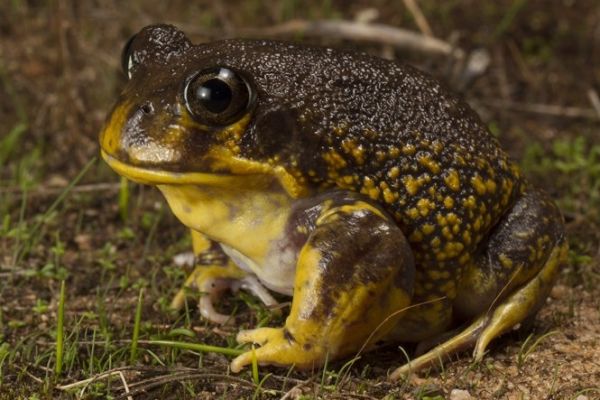
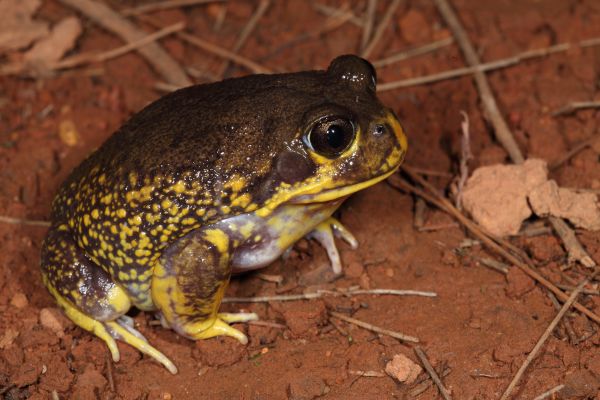
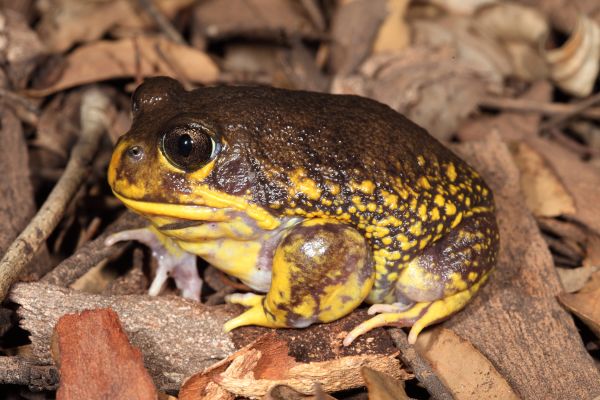
A large species of frog reaching up to 8.5 cm in body length. It has a dark brown or dark grey back. There is a yellow vertical stripe on the tip of the snout and a yellow stripe from the eye to the arm. The belly is white and purple, and the sides and limbs are spotted with bright yellow. The pupil is vertical and the iris is silver-grey. Fingers are unwebbed and toes slightly webbed, both without discs. Adult males have large black spines on their fingers during the breeding season.
Habitats
Occurs in claypans and sandy soil areas in dry forest.
Breeding Biology
Eggs are laid as a foamy mass out of the water inside burrows under rocks, tussocks, and logs near swamps and temporary watercourses. Tadpoles can reach a total length of up to 9 cm and are brown in colour, often with a gold patch behind each eye. They often remain on the bottom of water bodies and escape into still or flowing water bodies after their burrows are flooded, taking four to five months to develop into frogs. Breeds during autumn.
Similar Species
Looks similar to Heleioporus albopunctatus, Heleioporus eyrei, Heleioporus inornatus, and Heleioporus psammophilus in its distribution, but all of these species lack the yellow stripe from the eye to the arm present in Heleioporus barycragus.