Limnodynastes convexiusculus
Marbled Frog

Distribution
:quality(60)/https%3A//media.frogid.net.au/media/dd/images/y6g9r0zafqvahrvpwvz2.e0a74e7.png)
Conservation Status
What does it mean?
 Federal Conservation Status (EPBC Act)
IUCN Red List
 Least Concern
Frog Calls
Call recorded by Dane Trembath
Call recorded by Paul Doughty
Call recorded by Delma Clifton
Call recorded by Shane Craswell
Calling Period
- Jan
- peak
- Feb
- peak
- Mar
- peak
- Apr
- yes
- May
- possible
- Jun
- possible
- Jul
- No calling
- Aug
- No calling
- Sep
- possible
- Oct
- yes
- Nov
- yes
- Dec
- yes
Species Information
Description
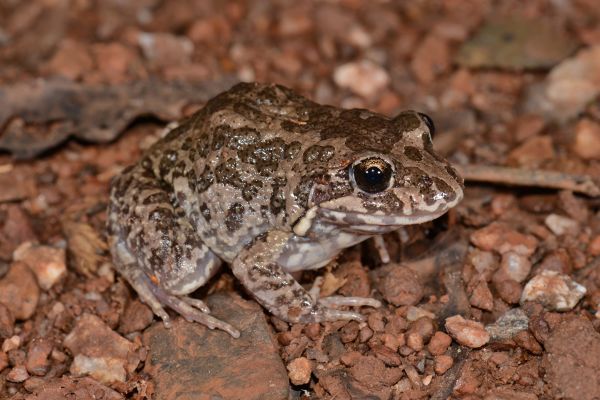
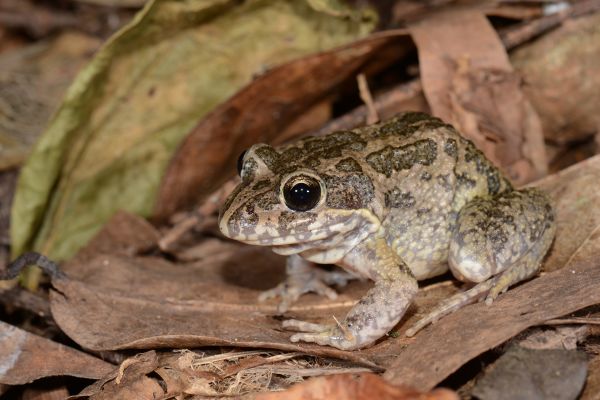
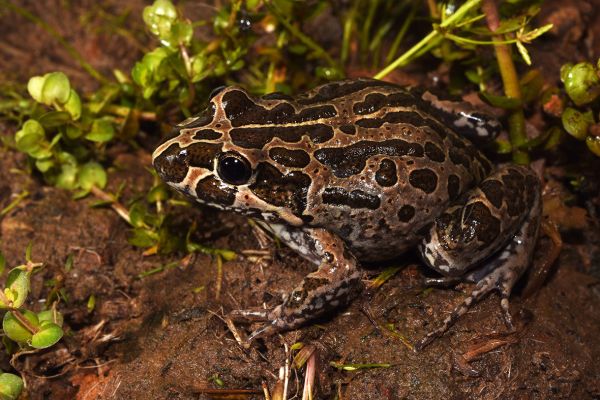
A large species of frog reaching up to 6 cm in body length. It has a brown back with darker brown or dark olive-green patches, and sometimes a thin longitudinal stripe along the middle. There is a wide, dark stripe from the tip of the snout to behind the eye. There is also a white stripe from under the eye to the arm. The belly is white.
The pupil is nearly round and the iris is gold. Fingers are unwebbed and toes are slightly webbed, both without discs.
Habitats
Occurs in savanna woodland and grassland.
Breeding Biology
Eggs are laid as a foamy mass on the surface of temporary ponds and swamps in flooded grassland. Tadpoles can reach a total length of up to 8 cm and are black in colour, or grey with brown spots. They often remain at the bottom of water bodies, and take around two months to develop into frogs.
Breeds during spring to summer in the wet season.
Similar Species
Looks similar to Limnodynastes depressus, Limnodynastes fletcheri, Limnodynastes lignarius, Limnodynastes peronii, and Limnodynastes tasmaniensis in its distribution, but has a different call to all of these species, and lacks multiple brown longitudinal stripes as present in Limnodynastes peronii. It also has a less flattened head shape compared to Limnodynastes depressus, and lacks the distinct and large tympanum of Limnodynastes lignarius.