Limnodynastes interioris
Giant Banjo Frog
Distribution
:quality(60)/https%3A//media.frogid.net.au/media/dd/images/yjilmntrqwiy4w45bpzf.b55d7c0.png)
Conservation Status
What does it mean?
 Federal Conservation Status (EPBC Act)
IUCN Red List
 Least Concern
Frog Calls
Call recorded by David Parker
Calling Period
- Jan
- yes
- Feb
- yes
- Mar
- yes
- Apr
- yes
- May
- possible
- Jun
- No calling
- Jul
- No calling
- Aug
- yes
- Sep
- peak
- Oct
- peak
- Nov
- peak
- Dec
- yes
Species Information
Description
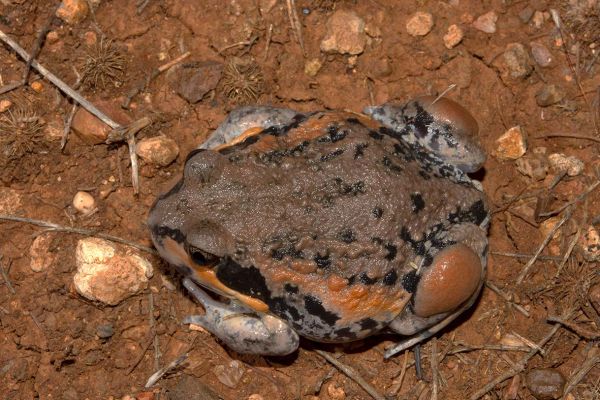
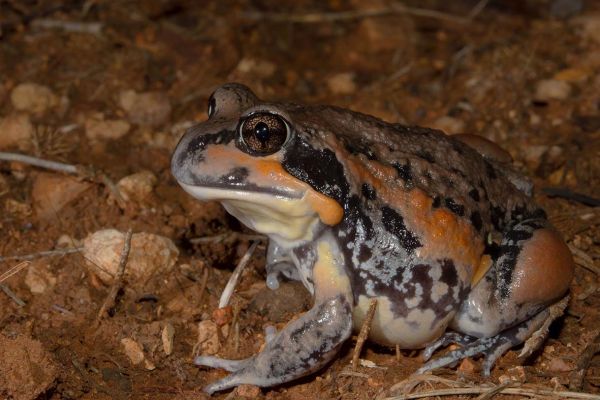
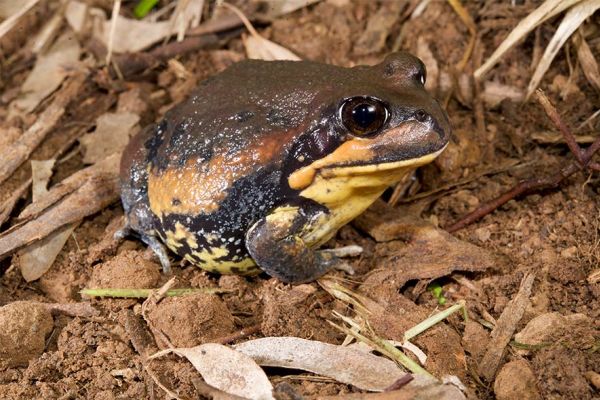
A large species of frog reaching up to 9 cm in body length. It has a beige or brown back with small black patches. There is a black stripe from the tip of the snout that widens along the side, with a bright orange or copper-coloured stripe above. There is an orange stripe from under the eye to the shoulder. The belly is yellow.
The pupil is horizontal and the iris is gold. Fingers are unwebbed and toes are about one-half webbed, both without discs.
Habitats
Occurs in mallee, woodland, and arid sandy regions.
Breeding Biology
Eggs are laid as a foamy mass on the surface of ponds, dams, flooded ditches, or stream pools. Tadpoles can reach a total length up to 9.5 cm and are grey-brown in colour, with gold clusters. They often remain on the bottom of water bodies, and take around two and a half months to develop into frogs.
Breeds during spring and summer. Occasionally breeds in autumn if there is adequate rain.
Similar Species
Looks similar to Limnodynastes dumerilii and Limnodynastes grayi in its distribution, but has more toe webbing and is generally larger than both species, and lacks the bright red markings on the inner thighs present in Limnodynastes grayi.