Limnodynastes lignarius
Woodworker Frog

Distribution
:quality(60)/https%3A//media.frogid.net.au/media/dd/images/bisytkj3nvsdc2rjzxrv.271be23.png)
Conservation Status
What does it mean?
 Federal Conservation Status (EPBC Act)
IUCN Red List
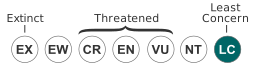 Least Concern
Frog Calls
Call recorded by Paul Doughty
Call recorded by Kylie Cowan
Calling Period
- Jan
- yes
- Feb
- yes
- Mar
- yes
- Apr
- possible
- May
- No calling
- Jun
- No calling
- Jul
- No calling
- Aug
- No calling
- Sep
- No calling
- Oct
- No calling
- Nov
- No calling
- Dec
- yes
Species Information
Description
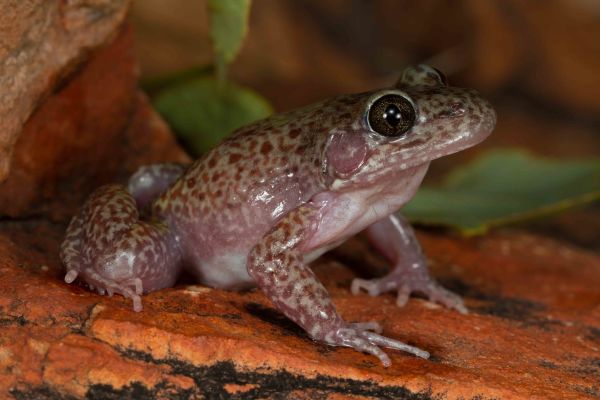
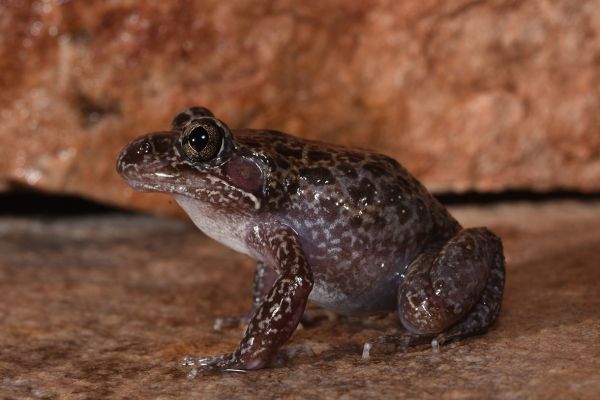
A large species of frog reaching up to 6.5 cm in body length. Two colour forms are recognised, each with a separate distribution. Form 1 has a light grey-brown back with brown patches; form 2 has a dark brown-purple back, with or without gold-brown patches. The belly is white or brown-purple.
The pupil is vertical and the iris is copper-coloured or gold. Fingers are unwebbed and toes are slightly webbed, both without discs. Form 1 males have tiny black spines along the upper lip and on the sides and limbs. Both forms have a distinct and large tympanum, which frogs use to hear, located just behind the eye.
Habitats
Occurs in rock crevices near creeks in escarpments.
Breeding Biology
Eggs are laid as a foamy mass on the surface of rock pools. Form 1 tadpoles can reach a total length of up to 7.5 cm and form 2 up to 6.5 cm. Both forms are brown or black in colour, with distinct black spots visible only in light brown individuals. They use their large mouthparts to stick to rocks in order to avoid being swept away by flowing water, and take around two months to develop into frogs.
Breeds during summer to autumn in the wet season.
Similar Species
Looks similar to Limnodynastes convexiusculus and Limnodynastes depressus in its distribution, but has a large and distinct tympanum lacking in both of these species. It has a less flattened head shape than Limnodynastes depressus.