Pelodryas gilleni
Centralian Tree Frog


Distribution
:quality(60)/https%3A//media.frogid.net.au/media/dd/images/sojuacsc5wqydntelsgt.4501648.png)
Conservation Status
What does it mean?
 Federal Conservation Status (EPBC Act)
IUCN Red List
 Least Concern
Frog Calls
Call recorded by Marie Callins
Calling Period
- Jan
- yes
- Feb
- possible
- Mar
- No calling
- Apr
- No calling
- May
- No calling
- Jun
- No calling
- Jul
- No calling
- Aug
- No calling
- Sep
- possible
- Oct
- yes
- Nov
- yes
- Dec
- peak
Species Information
Description
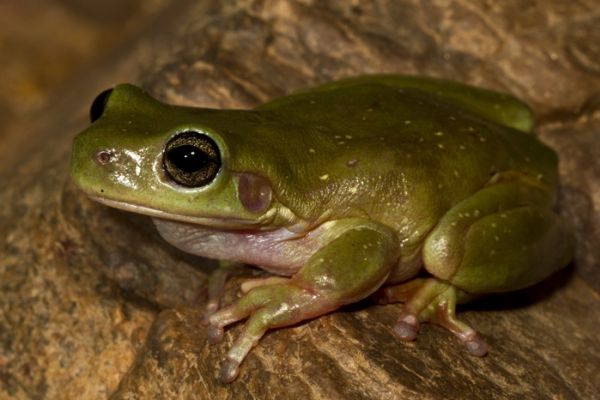
A large species of frog reaching up to 8 cm in body length. It has a bright green or olive-green back, with white or cream-coloured spots. The belly is white, and the male has a pale pink throat.
The pupil is horizontal, and the iris is gold. The fronts and backs of the thighs are yellow. Fingers are slightly webbed and toes are three-quarters webbed, both with large discs.
This species was previously known as Litoria gilleni.
Habitats
Occurs in boulder fields and rock crevices.
Breeding Biology
Eggs are laid as clusters that sink to the bottom of rock pools or river pools. Tadpoles can reach a total length of up to 7.5 cm, and are olive-brown or gold-brown in colour. They often remain at the bottom of water bodies. It is unknown how long they take to develop into frogs.
Breeds during summer after rain.
Similar Species
Does not look similar to any other species in its distribution.