Litoria larisonans
Western Desert Tree Frog
Distribution
:quality(60)/https%3A//media.frogid.net.au/media/dd/images/piurwxnq8jiedtnwe8u2.0a9a11c.png)
Conservation Status
What does it mean?
 Federal Conservation Status (EPBC Act)
IUCN Red List
 Not Evaluated
Frog Calls
Call recorded by Therese Mitchell
Call recorded by Kerry French
Call recorded by Desert11 Cole
Calling Period
- Jan
- peak
- Feb
- peak
- Mar
- yes
- Apr
- yes
- May
- yes
- Jun
- possible
- Jul
- possible
- Aug
- yes
- Sep
- yes
- Oct
- yes
- Nov
- peak
- Dec
- peak
Species Information
Description
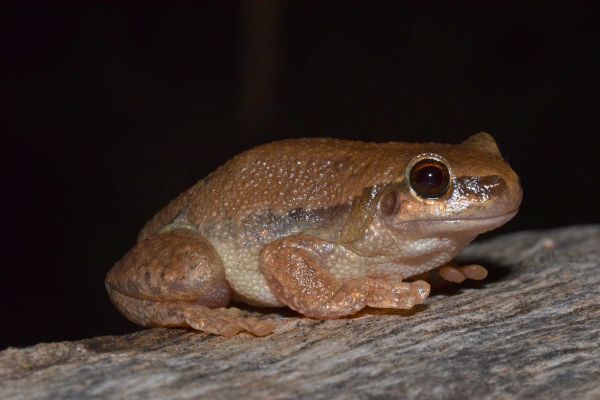
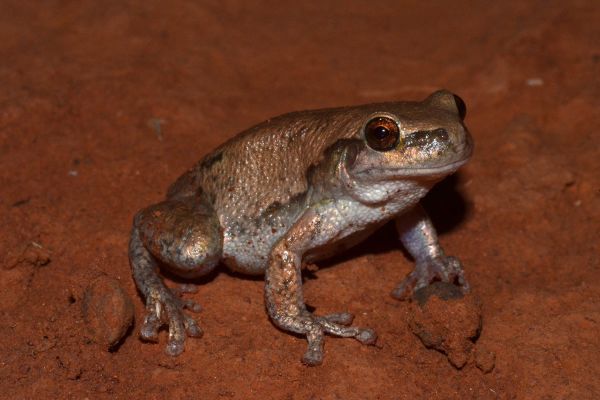
A medium-sized species of frog reaching up to 4 cm in body length. Body shape varies from gracile to robust. It has a red-brown, brown, cream, or pale grey back, with or without darker patches or mottling. There is a distinct, dark brown stripe from the tip of the snout to the groin, sometimes ending at the arm, or becoming patches at the side. The belly is cream and uniform in colour, and the male has a grey throat. The pupil is horizontal and the iris is gold to copper-brown. The groin is sometimes pale yellow to dull red, occasionally with spots similar to the colour of the dorsal surface. Fingers are slightly webbed and toes are half webbed, both with large discs. Until 2025, this species was considered to be the western lineage of Australia’s most widely-distributed frog, Litoria rubella. However, a study led by the University of Western Australia and co-authored by researchers from the Australian Museum used a combination of morphological, genetic, and acoustic analyses to reveal that this lineage is a distinct species. FrogID recordings helped reveal this species as new to science.
Habitats
Occurs in a wide range of habitats including woodland, plains, rocky ranges, and deserts, including around human habitation.
Breeding Biology
Eggs are laid as small clusters that are attached to vegetation near the surface of the water in ponds, dams, flooded ditches, and most other available still fresh water bodies. Tadpoles can reach a total length of up to 5.5 cm, and are grey-brown in colour, sometimes with many black spots. They often swim in the mid-depths and surface areas of water bodies, and take around one month to develop into frogs. Breeds during spring to autumn.
Similar Species
Does not look similar to any other species in its distribution.