Litoria rothii
Northern Laughing Tree Frog
Distribution
:quality(60)/https%3A//media.frogid.net.au/media/dd/images/kw09dzh8gryqt7xf0zho.ecbc1a1.png)
Conservation Status
What does it mean?
 Federal Conservation Status (EPBC Act)
IUCN Red List
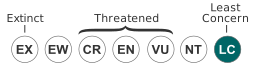 Least Concern
Frog Calls
Call recorded by Ann Bell
Call recorded by Dane Trembath
Call recorded by Dane Trembath
Calling Period
- Jan
- peak
- Feb
- peak
- Mar
- peak
- Apr
- possible
- May
- possible
- Jun
- possible
- Jul
- possible
- Aug
- possible
- Sep
- yes
- Oct
- peak
- Nov
- peak
- Dec
- peak
Species Information
Description
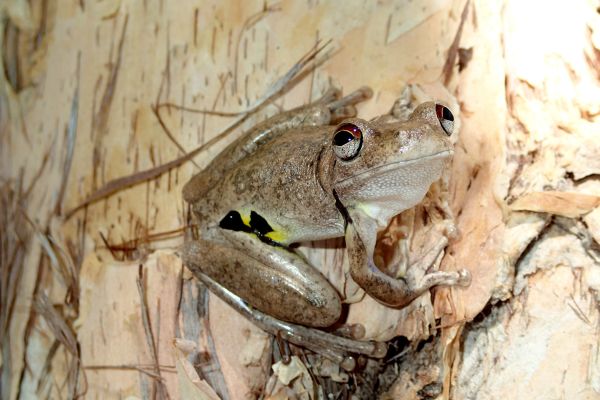
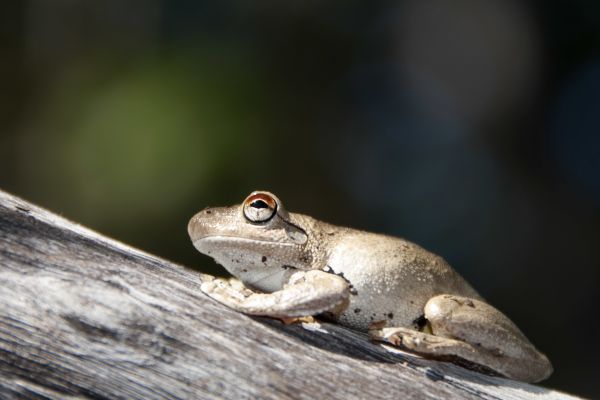
A medium-sized species of frog reaching up to 6 cm in body length. It has a grey, brown, reddish-brown or yellow-brown back, often with pale brown mottling. There is often a thin black stripe from behind the eye to the arm. The belly is white, and the male has a white throat. The pupil is horizontal, and the iris is red in the upper half, and silver in the lower half. The armpits, groin, and back of the thigs are glossy brown or black, with bright yellow or orange patches. Fingers are one-third webbed, and toes are nearly fully webbed, both with large discs. The distribution of this species was previously considered to extend into northern WA and the Top End of the NT, but recent research involving the Australian Museum and including analysis of FrogID recordings (published October 2023) has revealed the western populations to be a distinct species, Litoria ridibunda. A taxonomic revision of the Australian treefrogs published in June 2025 has suggested that this species be placed in the genus Pengilleyia, resulting in the proposed species name of Pengilleyia rothii.
Habitats
Occurs in woodland, farmland and suburban areas near waterside vegetation.
Breeding Biology
This species breeds in a wide variety of habitats, including woodlands, forests, rural, and urban habitats. Breeding mostly occurs on the edges of permanent ponds or temporarily flooded areas. Eggs are laid singly, or in small clusters under the surface of the water. Tadpoles can reach a total length of up to nearly 10 cm, and are yellow or brown in colour, sometimes with bright red dots on the tail. They often remain at the surface of water bodies, and take around two months to develop into frogs. Breeding occurs during spring and summer, during the Australian Monsoon Tropics wet season.
Similar Species
Looks similar to Litoria peronii and Litoria tyleri in its distribution, but has red in the upper half of the iris. It is distinguished from Litoria ridibunda by thigh colouration, where Litoria rothii has glossy brown or black thighs with bright yellow or orange patches, and Litoria ridibunda has more dull, matte brown or black thighs with bright yellow or orange patches. Litoria rothii has a shorter call (an average of 5-10 notes) compared to Litoria ridibunda (an average of 9-18 notes).