Litoria splendida
Magnificent Tree Frog
Distribution
:quality(60)/https%3A//media.frogid.net.au/media/dd/images/lqreljpf3zapphfzsi2m.43c11ac.png)
Conservation Status
What does it mean?
 Federal Conservation Status (EPBC Act)
IUCN Red List
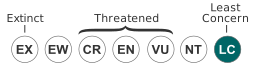 Least Concern
Frog Calls
Call recorded by Paul Doughty
Calling Period
- Jan
- yes
- Feb
- possible
- Mar
- No calling
- Apr
- No calling
- May
- No calling
- Jun
- No calling
- Jul
- No calling
- Aug
- No calling
- Sep
- possible
- Oct
- yes
- Nov
- yes
- Dec
- yes
Species Information
Description
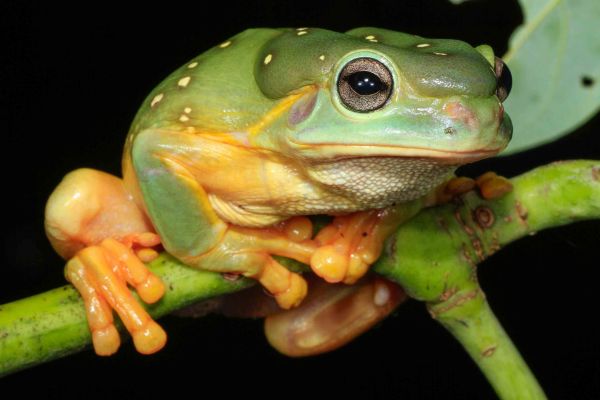
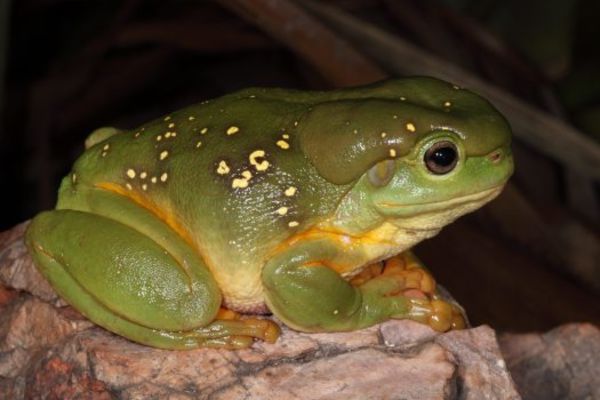
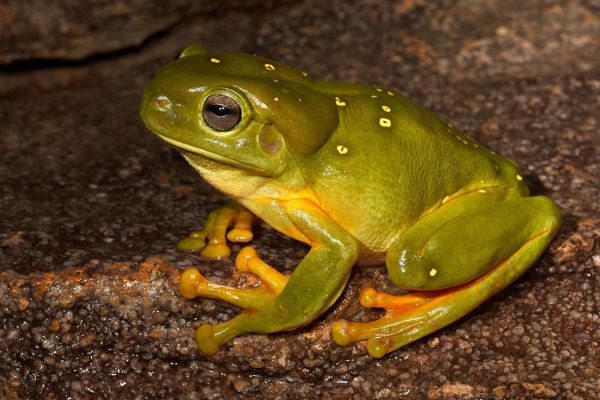
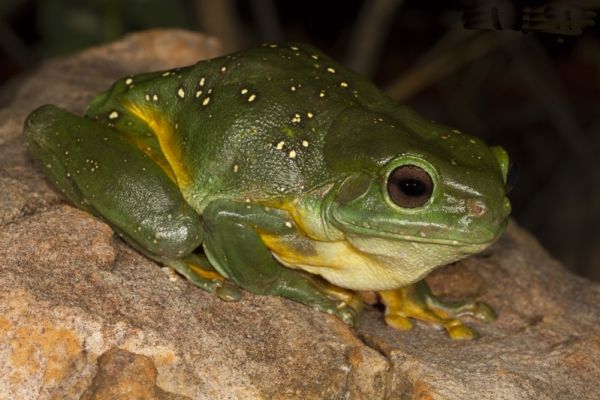
A large species of frog reaching up to 12 cm in body length. It has a bright green back, with white or yellow spots. The belly is white. The pupil is horizontal and the iris is gold. The armpits, groin and backs of the thighs are bright yellow or orange. Fingers are unwebbed and toes are nearly fully webbed, both with very large discs. There are big glands on the head and above the shoulders. A taxonomic revision of the Australian treefrogs published in June 2025 has suggested that this species be placed in the genus Pelodryas, resulting in the proposed species name of Pelodryas splendida.
Habitats
Occurs in caves and among boulders, as well as in nearby buildings.
Breeding Biology
Eggs are laid as small floating clusters that sometimes sink to the bottom of rock pools. Tadpoles can reach a total length of up to 6.5 cm and are grey-brown in colour, with some white spots. They swim throughout all depths of water bodies, and may take around three to four months to develop into frogs. Breeds during summer in the wet season.
Similar Species
Looks similar to Litoria caerulea and Litoria cavernicola in its distribution, but has big glands on the head and above the shoulders.