Litoria tornieri
Black-shinned Rocket Frog


Distribution
:quality(60)/https%3A//media.frogid.net.au/media/dd/images/cxy665jejpl9qunq3uag.b2d57cf.png)
Conservation Status
What does it mean?
 Federal Conservation Status (EPBC Act)
IUCN Red List
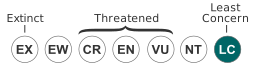 Least Concern
Frog Calls
Call recorded by Dane Trembath
Call recorded by Jodi Rowley
Call recorded by Paul Doughty
Calling Period
- Jan
- peak
- Feb
- peak
- Mar
- yes
- Apr
- yes
- May
- No calling
- Jun
- No calling
- Jul
- No calling
- Aug
- No calling
- Sep
- No calling
- Oct
- possible
- Nov
- yes
- Dec
- yes
Species Information
Description
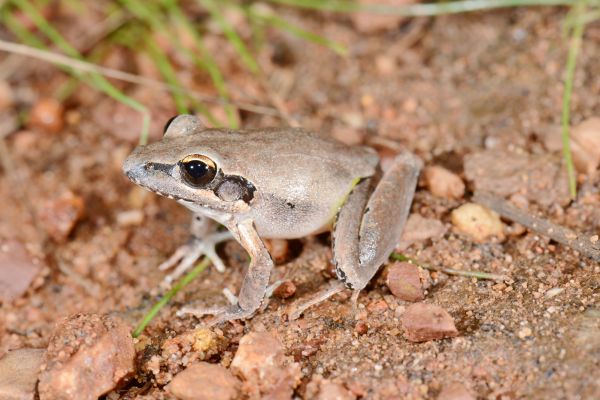
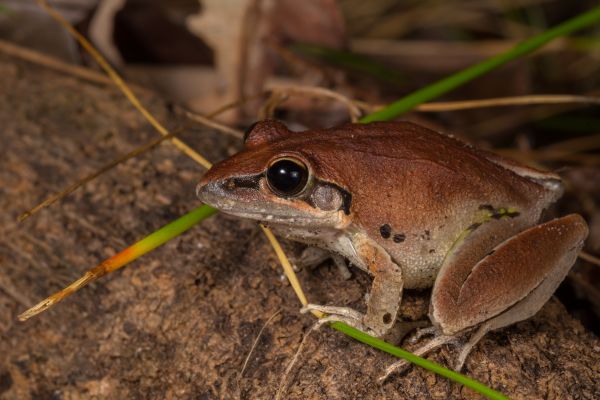
A medium-sized species of frog reaching up to 3.5 cm in body length. It has a reddish-brown or brown back. There is a black stripe from the tip of the snout to the arm, and often several black spots or small patches along the side. There is often a white or pale brown stripe along the upper lip, and sometimes a series of vertical white bars along the lower lip. The belly is white, and the male has a yellow stripe on the upper lip and pale pink sides when calling.
The pupil is horizontal and the iris is gold in the upper half, and dark brown in the lower half. The backs of the thighs are yellow, with black longitudinal markings. Fingers are unwebbed and toes are half webbed, both with small discs.
A taxonomic revision of the Australian treefrogs published in June 2025 has suggested that this species remain in the genus Litoria, retaining its species name of Litoria tornieri.
Habitats
Occurs in floodplains and open grassland.
Breeding Biology
Eggs are laid as clusters that float near the surface of the water, then later sink, in temporary pools, ponds, swamps, and ditches. Tadpoles can reach a total length of up to 4.5 cm and are light gold in colour, with a bright red tail. They swim throughout all levels of water bodies, and take around one and a half months to develop into frogs.
Breeds during spring to summer in the wet season.
Similar Species
Looks very similar to the many other rocket frog species in its distribution. Looks most similar to Litoria inermis and Litoria pallida in its distribution, but has smoother skin than Litoria inermis, and has a different back colour pattern to Litoria pallida.