Mixophyes australis
Southern Stuttering Frog
Distribution
:quality(60)/https%3A//media.frogid.net.au/media/dd/images/ebry0gp2yvfxi44gbjrs.21353cf.png)
Conservation Status
What does it mean?
 Federal Conservation Status (EPBC Act)
IUCN Red List
 Unlisted
Frog Calls
Call recorded by Jodi Rowley
Call recorded by Jodi Rowley
Calling Period
- Jan
- yes
- Feb
- yes
- Mar
- yes
- Apr
- possible
- May
- no
- Jun
- no
- Jul
- no
- Aug
- yes
- Sep
- peak
- Oct
- peak
- Nov
- peak
- Dec
- yes
Species Information
Description
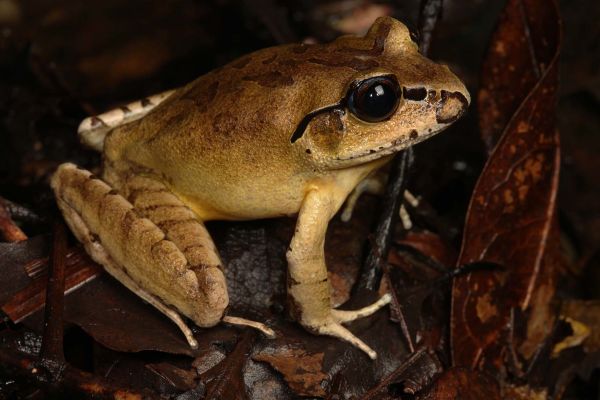
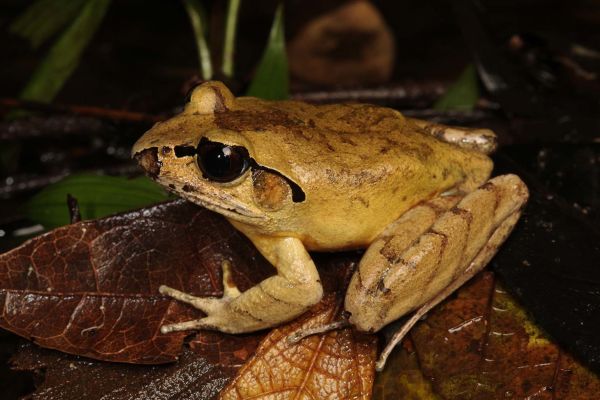
A large species of frog reaching up to 8 cm in body length. It has a yellowish-hued light brown to dark grey-brown back, with a darker longitudinal stripe or series of patches along the middle. There is a black stripe from the nostril to past the eye and above the tympanum, and a dark triangular patch on the tip of the snout. The belly is white or yellow.
This species was previously confused with the closely-related Mixophyes balbus. A genetic study in 2023 revealed that frogs in the southern part of the range of range of Mixophyes balbus were actually a seperate species, now named Mixophyes australis.
Habitats
Occurs near rocky streams in rainforest and wet sclerophyll forest.
Breeding Biology
Eggs are laid loosely or in clusters in very shallow water in wet gravel or leaf litter nests that are dug next to rocky streams. Tadpoles can reach a total length of up to 8 cm, and are dark grey or nearly black in colour. They often remain at the bottom of water bodies and take at least 15 months to develop into frogs.
Breeds during spring to autumn after rain.
Similar Species
Looks similar to Mixophyes fasciolatus and Mixophyes iteratus in its distribution, but has a different eye colour to both of these species, and is generally smaller than Mixophyes iteratus. Also looks very similar to Mixophyes balbus, but the two species’ ranges are narrowly separated by the Macleay River, with Mixophyes australis to the south and Mixophyes balbus to the north.