Neobatrachus albipes
White-footed Trilling Frog
Distribution
:quality(60)/https%3A//media.frogid.net.au/media/dd/images/i2soorzhfcjh3ocb9lml.4062bcc.png)
Conservation Status
What does it mean?
 Federal Conservation Status (EPBC Act)
IUCN Red List
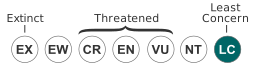 Least Concern
Frog Calls
Call recorded by Dale Roberts
Calling Period
- Jan
- yes
- Feb
- possible
- Mar
- yes
- Apr
- yes
- May
- yes
- Jun
- No calling
- Jul
- No calling
- Aug
- No calling
- Sep
- yes
- Oct
- peak
- Nov
- yes
- Dec
- yes
Species Information
Description
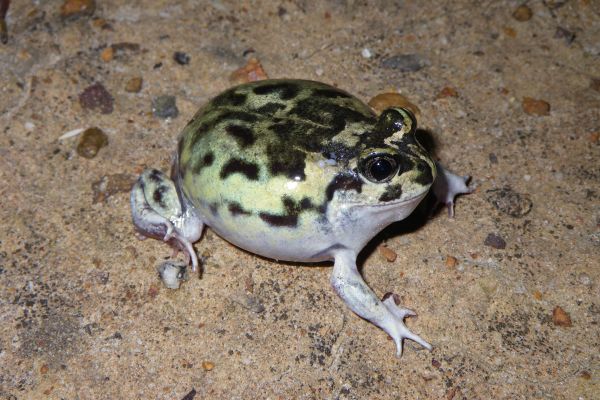
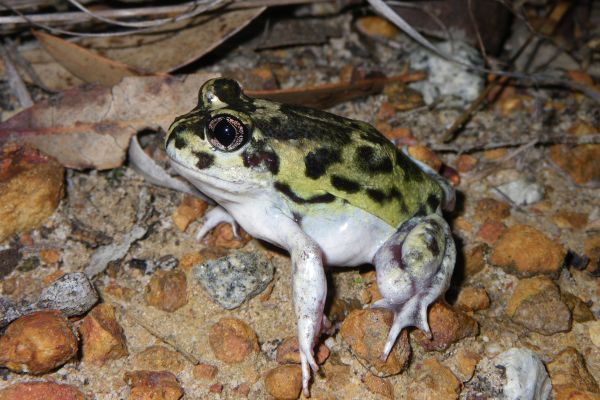
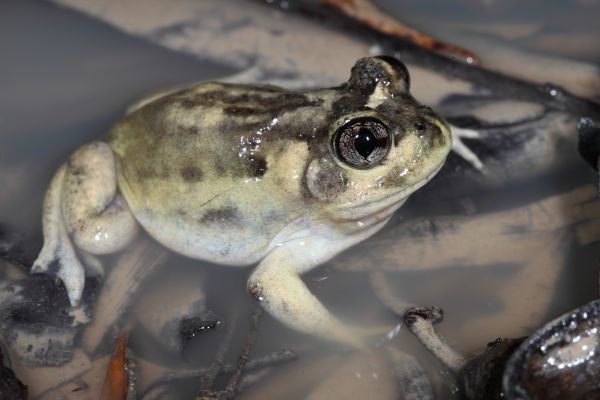
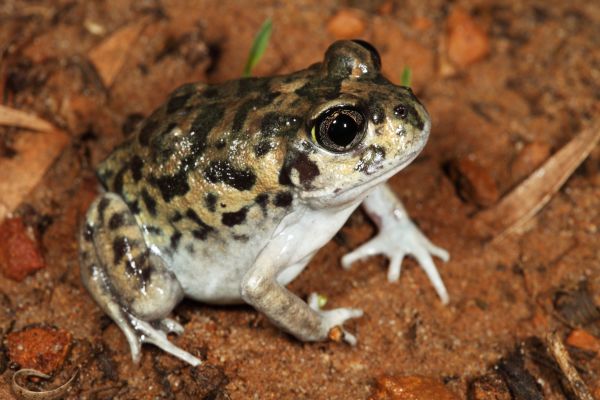
A medium-sized species of frog reaching up to 4.5 cm in body length. It has a brown, grey or cream-coloured back, with dark brown or olive-green marbling. The belly is white. The pupil is vertical, and the iris is silver-gold. Fingers are unwebbed and toes are three-quarters webbed, both without discs. The hands and feet are white on the upper surface. There is also a metatarsal tubercle on the bottom of each foot: this is a shovel-shaped lump used for burrowing.
Habitats
Occurs in bushland and farmland, often underground in burrows waiting for heavy rain.
Breeding Biology
Eggs are laid singly and in small clusters that are attached to vegetation under the surface of the water in temporary ponds, swamps, and flooded farmland. Tadpoles can reach a total length of up to 7 cm, and are grey-silver or gold-brown in colour with black specks. They swim at all depths of water bodies, and take around two and a half months to develop into frogs, although tadpoles that don't develop before winter can take much longer. Breeds during any time of the year after heavy rain, except winter.
Similar Species
Looks similar to Neobatrachus pelobatoides, Neobatrachus kunapalari, and Neobatrachus sutor in its distribution, but Neobatrachus kunapalari is larger; Neobatrachus pelobatoides has a thin pale or red longitudinal stripe along the middle of the back and lacks white on the upper surface of the hands and feet. The easiest way to distinguish Neobatrachus sutor is by its call.