Notaden nichollsi
Desert Spadefoot

Distribution
:quality(60)/https%3A//media.frogid.net.au/media/dd/images/hpo3wjvxwpevdm7ru3bz.d6a7ae2.png)
Conservation Status
What does it mean?
 Federal Conservation Status (EPBC Act)
IUCN Red List
 Least Concern
Frog Calls
Call recorded by H.B. Hines QPWS
Calling Period
- Jan
- yes
- Feb
- yes
- Mar
- yes
- Apr
- No calling
- May
- No calling
- Jun
- No calling
- Jul
- No calling
- Aug
- No calling
- Sep
- No calling
- Oct
- No calling
- Nov
- No calling
- Dec
- yes
Species Information
Description
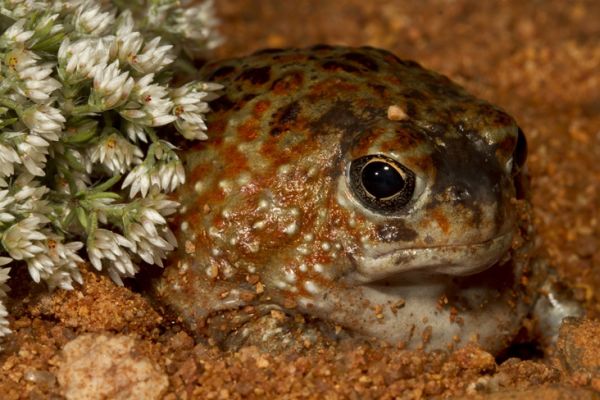
A large species of frog reaching up to 6.5 cm in body length. It has a grey or brown back, covered with small orange-red and black spots and patches. There are white spots on the side. There are dark vertical patches from the upper lip to the nostril and from the upper lip to under the eye. The belly is white, and the male has a brown throat.
The pupil is horizontal or nearly round, and the iris is gold. Fingers are unwebbed and toes are slightly webbed, both without discs. Their skin can secrete a very sticky glue-like substance.
Habitats
Occurs in shrubland, grassland, and desert areas with clay soils.
Breeding Biology
Eggs are laid as a cluster at the surface of the water in small dams and temporary flooded ditches. Tadpoles can reach a total length of 5 cm, and are grey, gold, or dark brown in colour. They often remain on the bottom of water bodies, and take two weeks to one month to develop into frogs, although tadpoles in warm, shallow water bodies may develop faster.
Breeds during the summer wet season after heavy rain.
Similar Species
Looks similar to Notaden melanoscaphus in its distribution, but lacks four dark brown patches in a cross pattern on its back.