Philoria richmondensis
Richmond Mountain Frog

Distribution
:quality(60)/https%3A//media.frogid.net.au/media/dd/images/wc2xdgit4yrjicedlpio.6f53b23.png)
Conservation Status
What does it mean?
 Federal Conservation Status (EPBC Act)
IUCN Red List
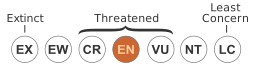 Endangered
Frog Calls
Call recorded by Stephen Mahony
Calling Period
- Jan
- yes
- Feb
- possible
- Mar
- No calling
- Apr
- No calling
- May
- No calling
- Jun
- No calling
- Jul
- possible
- Aug
- yes
- Sep
- yes
- Oct
- peak
- Nov
- yes
- Dec
- yes
Species Information
Description
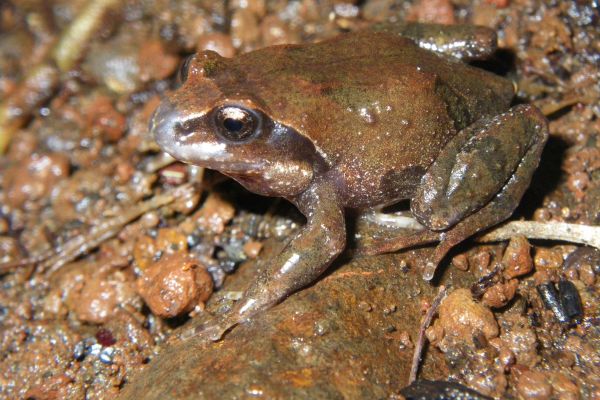
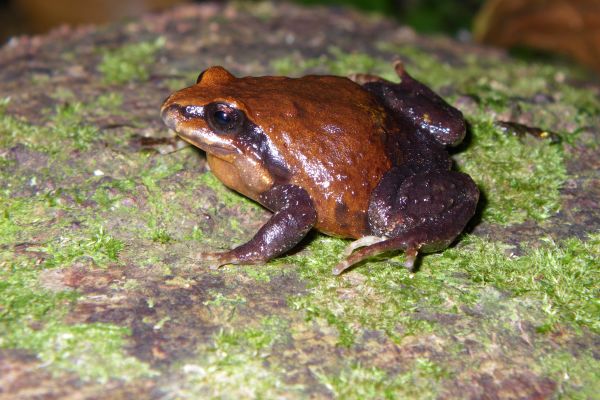
A small species of frog reaching up to 3 cm in body length. It has a yellow-orange or brown back with or without black patches. There is a black stripe from the tip of the snout to the arm. The belly is yellow or grey.
The pupil is horizontal, and the iris is gold in the upper half and brown in the lower half. The undersurfaces of the arms and legs are dark. Fingers and toes are unwebbed, both without discs. The female has large flanges on the first and second finger, which help to whip up protective foam around the eggs as they are laid.
Habitats
Occurs in mountainous rainforest in small creek beds and soaks.
Breeding Biology
Eggs are laid as a small foamy mass in shallow mud soaks, in or near small creek beds under rocks and vegetation. Tadpoles can reach a total length of up to 2 cm and are mostly transparent white, only developing dark grey colour in later growth stages. They often remain inside the broken-down egg mass feeding on their own yolk reserves, and take around one month to develop into frogs.
Breeds during late winter to summer.
Similar Species
Looks similar to Philoria knowlesi, Philoria kundagungan, Philoria loveridgei, and Philoria pughi near its distribution, but usually has a different back colour to Philoria kundagungan and Philoria loveridgei.