Pseudophryne covacevichae
Magnificent Brood Frog
Distribution
:quality(60)/https%3A//media.frogid.net.au/media/dd/images/ypve5r3zfnxfdqtqeskb.90b13cc.png)
Conservation Status
What does it mean?
 Federal Conservation Status (EPBC Act)
IUCN Red List
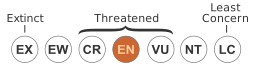 Endangered
Frog Calls
Call recorded by Stephen Mahony
Call recorded by Dave Stewart
Call recorded by Keith McDonald
Calling Period
- Jan
- yes
- Feb
- yes
- Mar
- yes
- Apr
- possible
- May
- possible
- Jun
- No calling
- Jul
- No calling
- Aug
- No calling
- Sep
- possible
- Oct
- yes
- Nov
- yes
- Dec
- yes
Species Information
Description
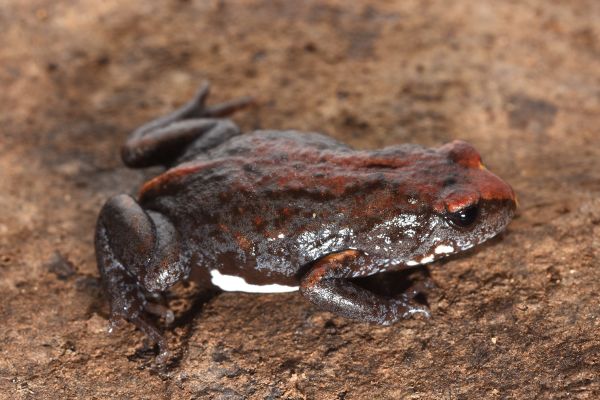
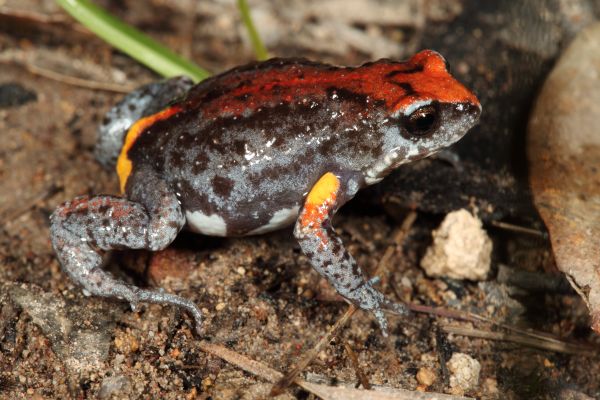
A small species of frog reaching up to 3 cm in body length. It has a grey or blue-grey back, with a bright yellow longitudinal stripe on the lower back and a large area of orange-red from the tip of the snout along the middle. The side is grey-brown with dark brown spots. The belly has black and white marbling.
The pupil is horizontal, and the iris is gold. The tops of the arms are bright yellow at the shoulder. Fingers and toes are unwebbed, both without discs.
Habitats
Occurs in open woodland and drainage lines near small creeks.
Breeding Biology
Eggs are laid as one small cluster on land under moist leaf litter and in muddy holes in the ground near small creeks. The nest is guarded by the male, as it is with other Pseudophryne species. Tadpoles can reach a total length of up to 3.5 cm, and are dark brown-gold in colour. They are released into water bodies after the nest is flooded by rain, and may take at least one month to develop into frogs once released.
Breeds during spring to summer after rain.
Similar Species
Does not look similar to any other species in its distribution.