Pseudophryne pengilleyi
Northern Corroboree Frog
Distribution
:quality(60)/https%3A//media.frogid.net.au/media/dd/images/hvfeyzpiuodkzq9kxfae.38fe7f5.png)
Conservation Status
What does it mean?
 Federal Conservation Status (EPBC Act)
IUCN Red List
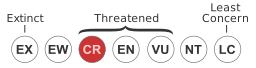 Critically Endangered
Frog Calls
Call recorded by Michael McFadden
Calling Period
- Jan
- yes
- Feb
- peak
- Mar
- yes
- Apr
- No calling
- May
- No calling
- Jun
- No calling
- Jul
- No calling
- Aug
- No calling
- Sep
- No calling
- Oct
- No calling
- Nov
- No calling
- Dec
- No calling
Species Information
Description
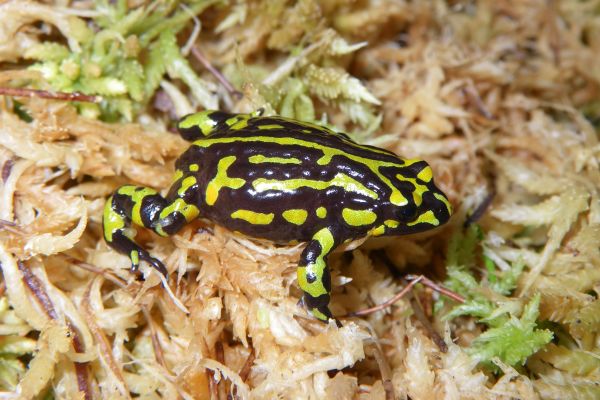
A small species of frog reaching up to 3 cm in body length. It has a distinct yellow- and black-striped back, with a green tinge to the yellow stripes. The same pattern extends over the limbs. The belly has white and black marbling, sometimes with pale yellow instead of white.
The pupil and iris are black. Fingers and toes are unwebbed, both without discs.
Habitats
Occurs in mountainous Sphagnum moss bogs and nearby woodland and heathland.
Breeding Biology
Eggs are laid as one small cluster on land in Sphagnum moss burrows. The nest is guarded by the male, as it is with other Pseudophryne species. Tadpoles can reach a total length of 3 cm, and are black in colour with tiny silver spots. They grow to an advanced stage inside the egg, and are released into water bodies after the nest is flooded by rain or snow melt in autumn or winter, taking six to seven months to develop into frogs once released.
Breeds only during summer in order to avoid the extreme climatic conditions of the Snowy Mountains.
Similar Species
Looks very similar to Pseudophryne corroboree, but has a slightly different distribution and yellow stripes with a green tinge, compared to the brighter yellow stripes of Pseudophryne corroboree.