Taudactylus diurnus
Southern Day Frog
Distribution
:quality(60)/https%3A//media.frogid.net.au/media/dd/images/tzukhjhoj4wiaahv7vrz.1bd62a3.png)
Conservation Status
What does it mean?
 Federal Conservation Status (EPBC Act)
IUCN Red List
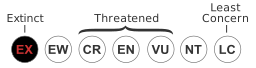 Extinct
Calling Period
- Jan
- yes
- Feb
- yes
- Mar
- yes
- Apr
- yes
- May
- yes
- Jun
- No calling
- Jul
- No calling
- Aug
- No calling
- Sep
- No calling
- Oct
- peak
- Nov
- peak
- Dec
- peak
Species Information
Description
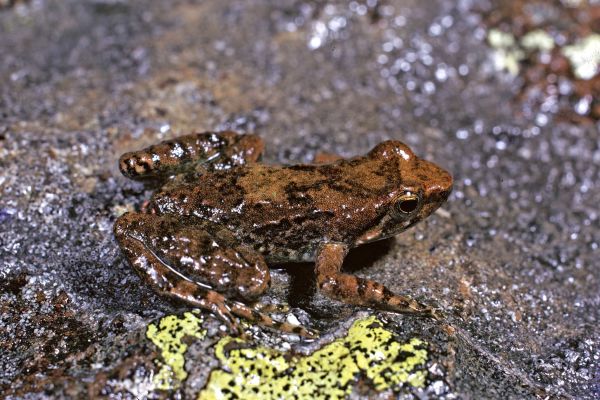
A small species of frog that reached up to 3 cm in body length. It had a grey or dark brown back, with darker patches. There was a dark stripe from the eye to the shoulder. There was also often a dark H-shaped marking between the shoulders, and a horizontal stripe between the eyes. The belly was white with dark grey-brown spots; the male had a darker throat.
Fingers and toes were unwebbed, both with small discs. The male lacked a vocal sac, which made the call quiet.
Habitats
Occurred near rocky streams in mountainous rainforest and wet sclerophyll forest.
Breeding Biology
Eggs were laid as a small cluster attached to rocks under the surface of the water. Only preserved tadpoles have been examined, with a total length of 3 cm and dark brown colour. They often remained at the bottom of water bodies, and used their mouthparts to stick to rocks in order to avoid being swept away by flowing water. It is unknown how long they took to develop into frogs.
Breeding was recorded during spring to summer.
Similar Species
Looks similar to Crinia deserticola, Crinia parinsignifera, Crinia signifera, and Crinia tinnula in its former distribution, but all of these species lack finger and toe discs.